

How to Size a 3 Phase Transformer | Simple kW & Current Formulas
Whether you’re installing imported machinery, designing a new electrical system, or expanding an existing facility, selecting the correct transformer size is essential.
Choose a transformer that’s too small, and it may overheat, experience excessive voltage drop, or have a reduced service life. Choose one that’s significantly larger than required, and you’ll spend more than necessary and potentially come up against inrush obstacles.
Fortunately, sizing a three-phase transformer is usually straightforward.
In this guide, we’ll show you two simple methods to determine the correct transformer size, based on what information you have. We will explain each method, and work through examples that can be applied to both straight isolation transformers, and auto transformers (step up / step-down transformers).
Key Takeaways
- Learn how to size a 3 Phase Transformer if you know the equipment’s kW OR the full load current required.
- Method 1 – how to size a 3 Phase Transformer IF you know the kW rating of your 3ph equipment.
- Method 2 – how to size a 3 Phase Transformer IF you know the full load current (A) of your load of your 3ph system/equipment.
- If you’re unsure, send us the equipment nameplate or datasheet and we’ll recommend the correct transformer.
Why Correct Transformer Sizing Matters
A transformer should be large enough to supply the connected load reliably throughout its operating life.
Correct sizing helps to:
- Maintain stable output voltage
- Reduce operating temperature
- Improve long-term reliability
- Allow for reasonable future expansion
- Avoid unnecessary capital cost
For many Australian manufacturers, transformer sizing also goes hand-in-hand with voltage conversion. Imported machinery commonly requires voltages such as 200V, 220V or 380V, while Australian sites typically supply 415V three-phase.
Selecting the correct transformer therefore means choosing both:
- the correct voltage ratio; and
- the correct kVA rating.
Method 1 — You Know the Equipment Power (kW)
This is how to size a 3 Phase Transformer IF you know the equipment kW rating required. You can quickly estimate the required transformer kVA size using:
Transformer Size (kVA) = kW × 1.25
This assumes a typical industrial power factor of approximately 0.8, making it an excellent starting point when current isn’t available.
Example
Equipment rating: 20kW
Calculation: 20kW × 1.25 = 25kVA
Recommended transformer: 25kVA
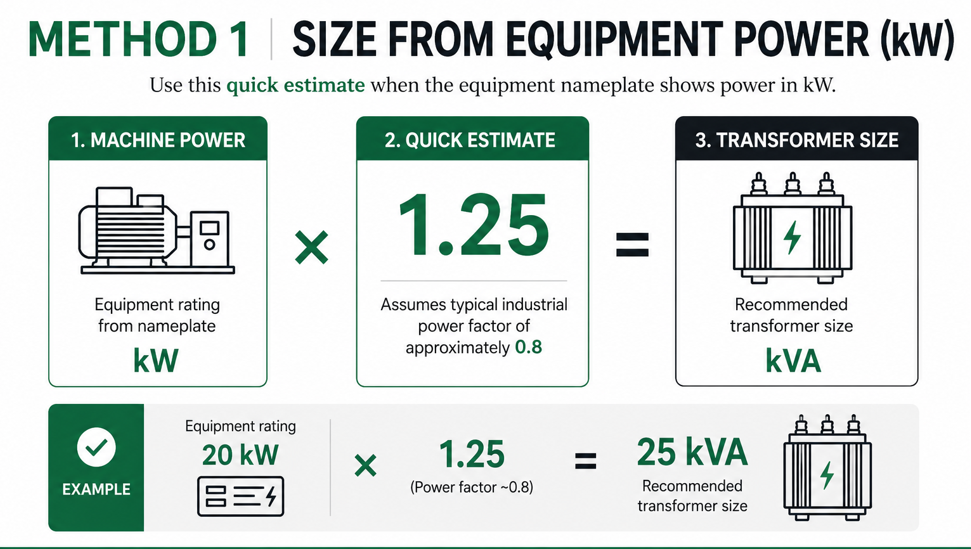
CalcPanel has a very handy calculator tool with this exact calculator in-built
Method 2 — You Know the Load Current (output Amps)
This is how to size a 3 Phase Transformer IF you know the system’s / equipment’s full-load current. This is generally the preferred sizing method.
Use the following formula:
VA = Voltage × Current x √3
Example
Voltage: 415V
Full Load Current: 100A
Calculation: 415 × 100 x √3 = 71,880 VA
VA ÷ 1000 = kVA = 71.9 kVA
Recommended transformer: 75 kVA
Using the equipment’s rated current provides the most reliable indication of the electrical demand placed on the transformer.

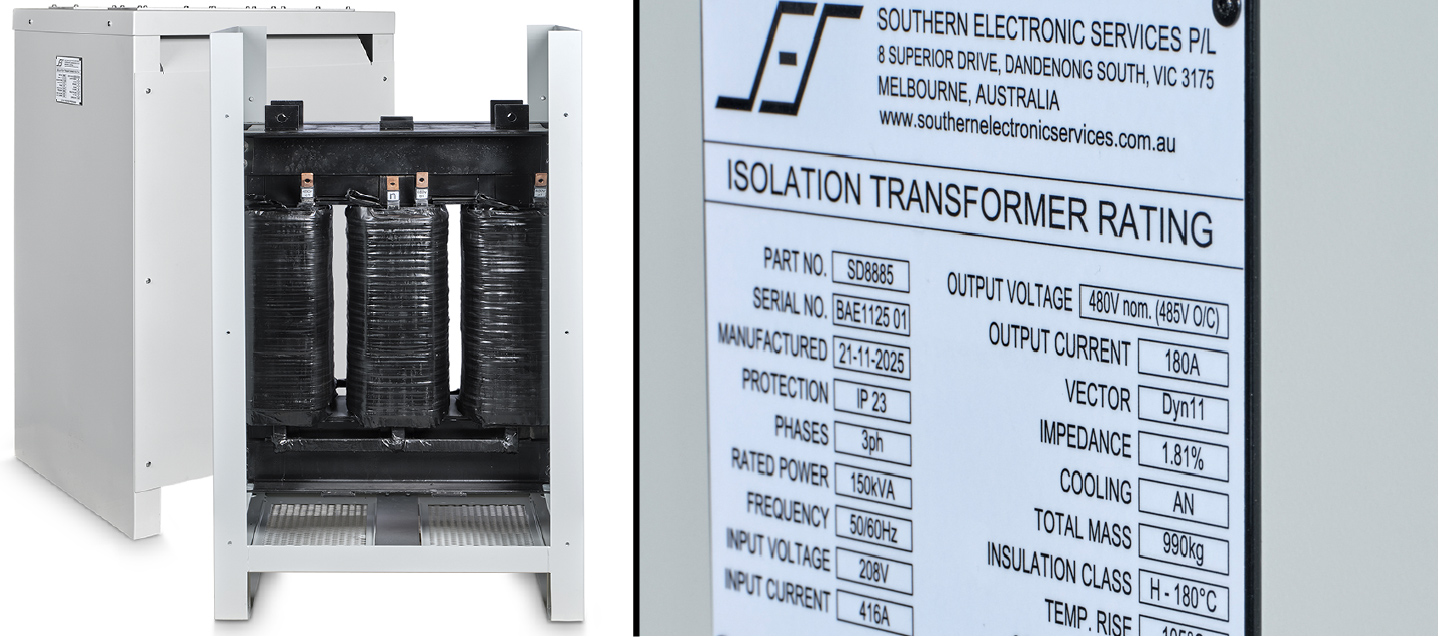
Isolation Transformer Example
A customer requires electrical isolation for a new 415V system.
Equipment details:
Supply Voltage: 415V
Full Load Current: 67A
Calculation: √3 × 415 × 67 ÷ 1000 = 48kVA
Recommended transformer:
415V / 415V @ 50kVA Three-Phase Isolation Transformer
This provides sufficient capacity while remaining cost-effective.
Step-Down Transformer Example
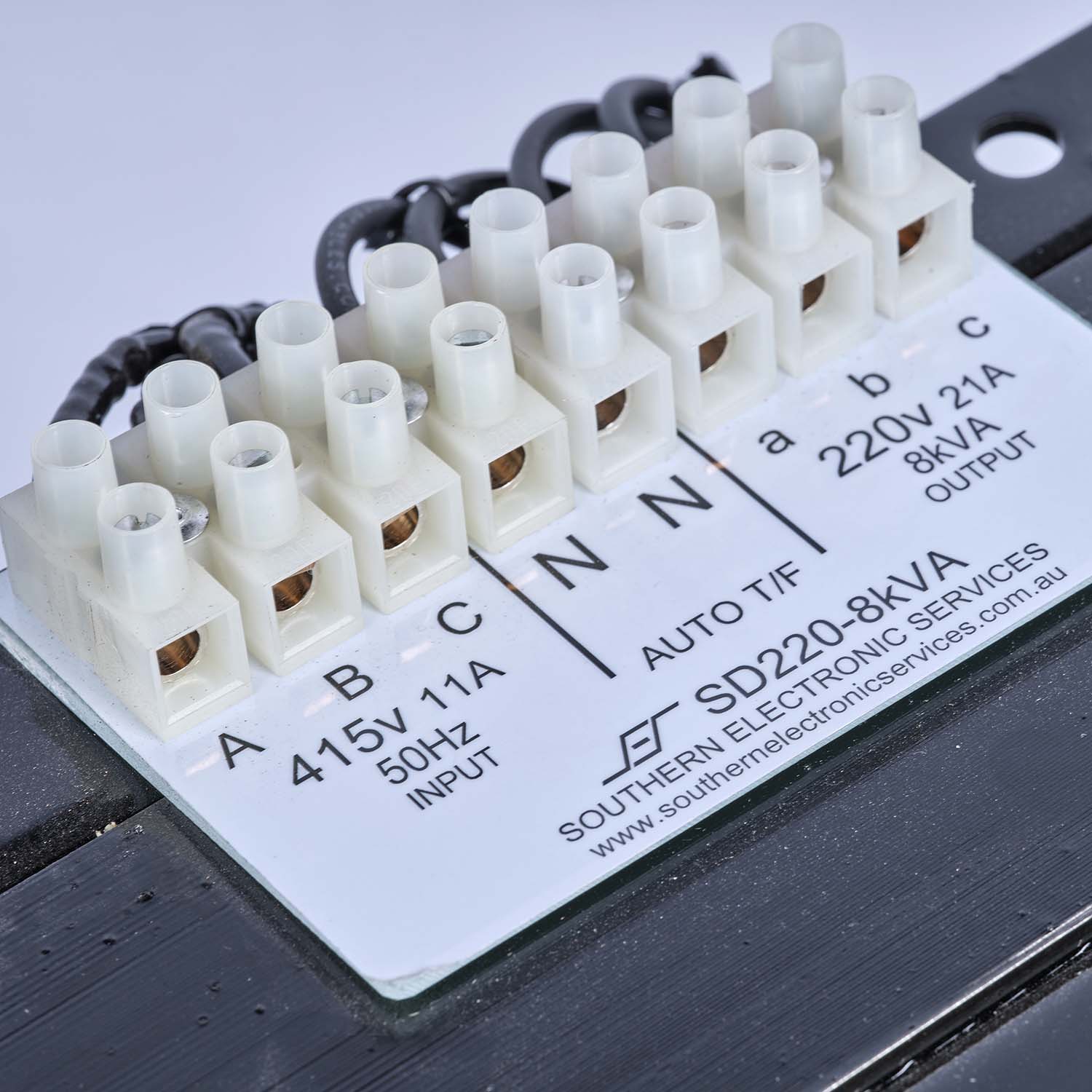
A customer imports equipment designed for a 200V supply.
Equipment details:
Site Supply: 415V
Machine Rating: 20kW
Calculation: 20 × 1.25 = 25kVA
Recommended transformer:
25kVA 415V / 200V Three-Phase Step-Down Autotransformer
This provides both the required voltage conversion and adequate transformer capacity for the equipment.
Standard Transformer Sizes
Most industrial transformers are manufactured in standard kVA ratings. Southern Transformers has a huge range of standard kVA rating sizes of sizes to suit almost every application, and can build to your specification.
Standard kVA Ratings – 3ph Transformers
10kVA | 15kVA | 20kVA | 25kVA | 30kVA | 40kVA | 50kVA | 60kVA | 75kVA | 100kVA | 125kVA | 150kVA | 200kVA | 200kVA | 250kVA | 300kVA | 350kVA | 350kVA | 400kVA | 500kVA | 600kVA | 750kVA
If your calculated load falls between two standard sizes, selecting the next available rating generally provides a practical operating margin while allowing for normal operating conditions and future equipment additions.
Check out our 3ph Isolation Transformer range
Check out our 3ph Step Down Transformers range
Which Method Should You Use?
If both the equipment power (kW) and current (amps) are available, we generally recommend sizing from the rated full-load current.
The current reflects the actual electrical demand placed on the transformer and usually provides the most accurate sizing basis.
Where only the equipment power is known, the kW × 1.25 method provides an excellent estimate for most industrial applications.
Common Transformer Sizing Mistakes
Avoid these common mistakes when selecting a transformer:
- Specifying a transformer using voltage alone.
- Ignoring the equipment’s rated full-load current.
- Forgetting to include all equipment operating from the transformer.
- Choosing a transformer with no allowance for future expansion.
When available, always refer to the equipment nameplate or manufacturer’s datasheet.
Need further help on how to size a 3 Phase Transformer?
Every application is different. We’re here to help you to specify the right Transformer.
If you’re unsure how to size a 3 Phase Transformer, or which transformer is best for your equipment, simply send us your machine nameplate, electrical schematic or datasheet.
Our engineering team will review your application and recommend the most suitable solution, whether that’s a three-phase isolation transformer, a step-down autotransformer or a custom-designed transformer built for your specific requirements.
Need advice? Contact Southern Transformers today for obligation-free sizing assistance.
Frequently Asked Questions
Should I size a transformer using kW or amps?
If the equipment’s full-load current is available, this generally provides the most accurate sizing method. If only kW is known, multiplying by 1.25 provides a practical estimate for many industrial applications.
Can a transformer be oversized?
Selecting the next standard transformer size is common practice and can provide additional operating margin. However, selecting a transformer significantly larger than required may increase the initial purchase cost, as well as cause inrush issues, resulting in needing to upgrade protective equipment (CB’s etc) and other system aspects.
Can one transformer supply multiple machines?
Yes. The transformer should be sized for the maximum total load that may operate simultaneously.
What information do I need to size a transformer?
You’ll need three key things to get an accurate estimate:
- Voltages required
Input voltage (supply), and
Output voltage (load/equipment) - Enclosure / Environmental Protection requirements
This determines the enclosure rating (IP Rating) the transformer will be fitted in, and can significantly impace size and price.
Indoor – Typically IP21 or IP23. Enclosure generally has air inlet and outlets
Outdoor – Typically IP54 or IP65. Enclsorue is generally sealed from dust and water ingress
Open-type [IP00] – If fitting transformer into exisitng DB/switchroom
Other (eg. wet indoor area [IP54], underground mine site [IP65], site-specific specification [IP2X – IP6X] - Load Requirements
You’ll typically need one of the following:
- Equipment full-load current (A)
- Equipment power (kW)
- Equipment apparent power (kVA)
- Equipment datasheet or nameplate
If you’re unsure, simply send us the nameplate and we’ll help determine the appropriate transformer size.
3ph equipment, kW rating transformer, sizing transformer, 3ph isolation transformer, 3-phase transformer, 415v transformer, 3 phase
Get the Latest in Power Transformer Solutions
Get industry insights, product updates, and exclusive offers


