
Specification
As we design & build all of our transformers in-house, we can provide the best solution for your site or application.
Unique electrical systems deserve engineered solutions, not a catalogue item.
Electrical Design Summary
- Voltages
Up to 6.6 kV on the medium-voltage side, 415 V on the low side, either direction - Rating
Up to 500 kVA - Configuration
Dyn11 standard; YNd11, Dyn1 and other vector groups to suit the system - Frequency
50 Hz, 60 Hz, or other - Construction
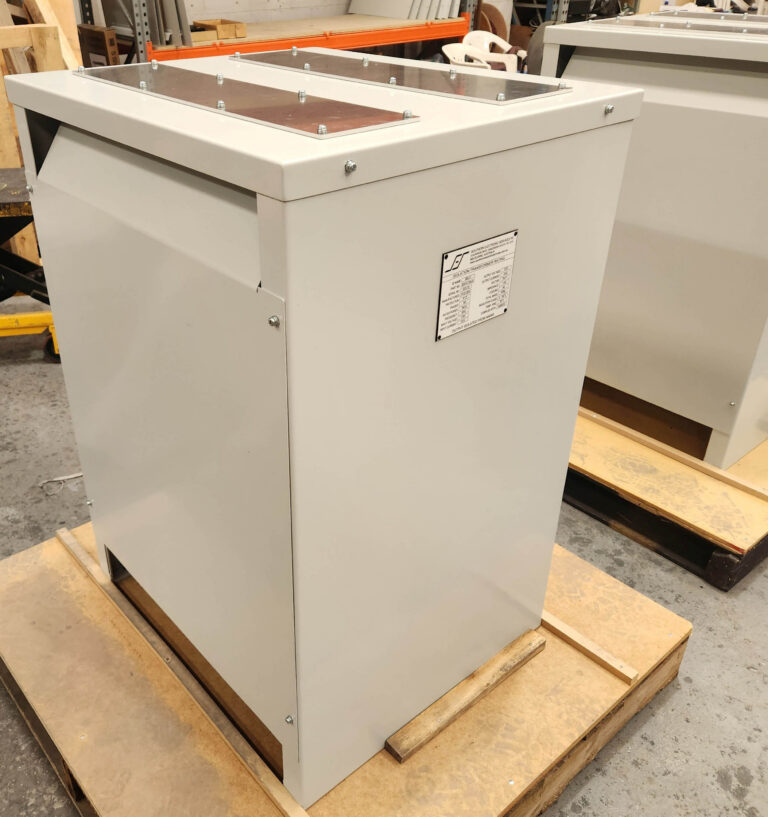
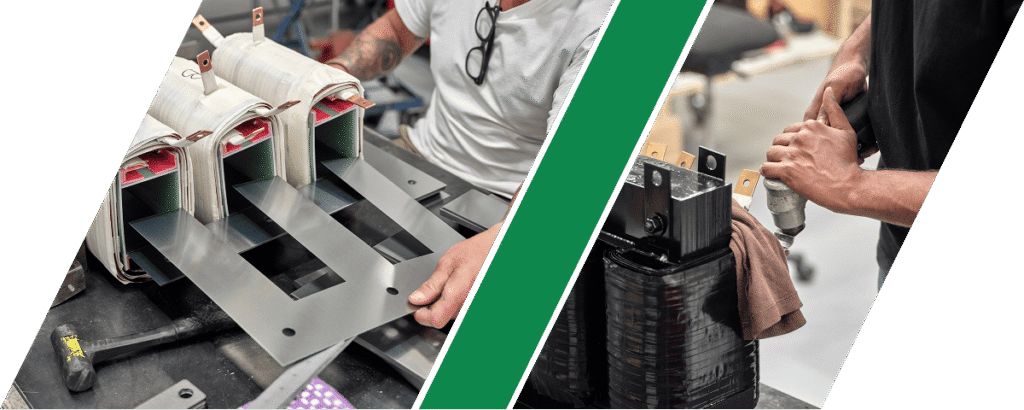
Open-wound dry-type, enamelled copper windings, premium core steel - Insulation
Class H — 180 °C - Impedance
2–4% typical, or designed to a specified value - Efficiency
Typically above 97.5% - Temperature rise
Typically under 115 °C - Cooling
Air natural (AN), or air forced (AF) where space is tight - Enclosures
Open (IP00), IP23, IP65, or custom
Compliance
- AS/NZS/IEC 60076
- AS/NZS/IEC 61558
- Every transformer is comprehensively Type Tested & Routine Tested
- Standard 5-year Warranty, with a 25+ year design life
Documentation
Provided as Standard with Every Transformer:
- Design stage:
Transformer Specification
Preliminary GA Drawing
Schematic - Upon Order:
Guaranteed leadtime
Progress updates - On Completion
AS60076 Test Report
FAT Report
5-year Warranty Statement
GA Drawing as built
O & M Manual
In order to provide you with the best MV/LV transformer solution for your requirements, the more information you can provide us, the better.
If you do not know specifics, thats fine – that’s what we’re here for. We’ve been around long enough to be able to evaluate most applications and recommend the right MV/LV transformer for your site and equipment.






Medium voltage on both sides is assessed on application rather than built to a standard design.
All three are legitimate. Which one suits depends far more on where the transformer is going and how standard the job is than on which is “better”.
Oil-filled gives the best cooling and the lowest cost per kVA at larger MV ratings, and it’s the default for utility-style pad-mount distribution. The cost is the oil: bunding and containment, fire separation, spill risk, and oil sampling for the life of the asset. On a lot of indoor and underground sites it simply isn’t permitted.
Cast resin encapsulates the windings in epoxy. It does very well in humid, dusty or chemically aggressive air, needs little maintenance, and is the usual choice where an indoor fire classification is specified. The trade-offs are that the moulds make one-off and non-standard units slow and expensive, and that an encapsulated winding can’t be repaired — if it fails, the unit is replaced.
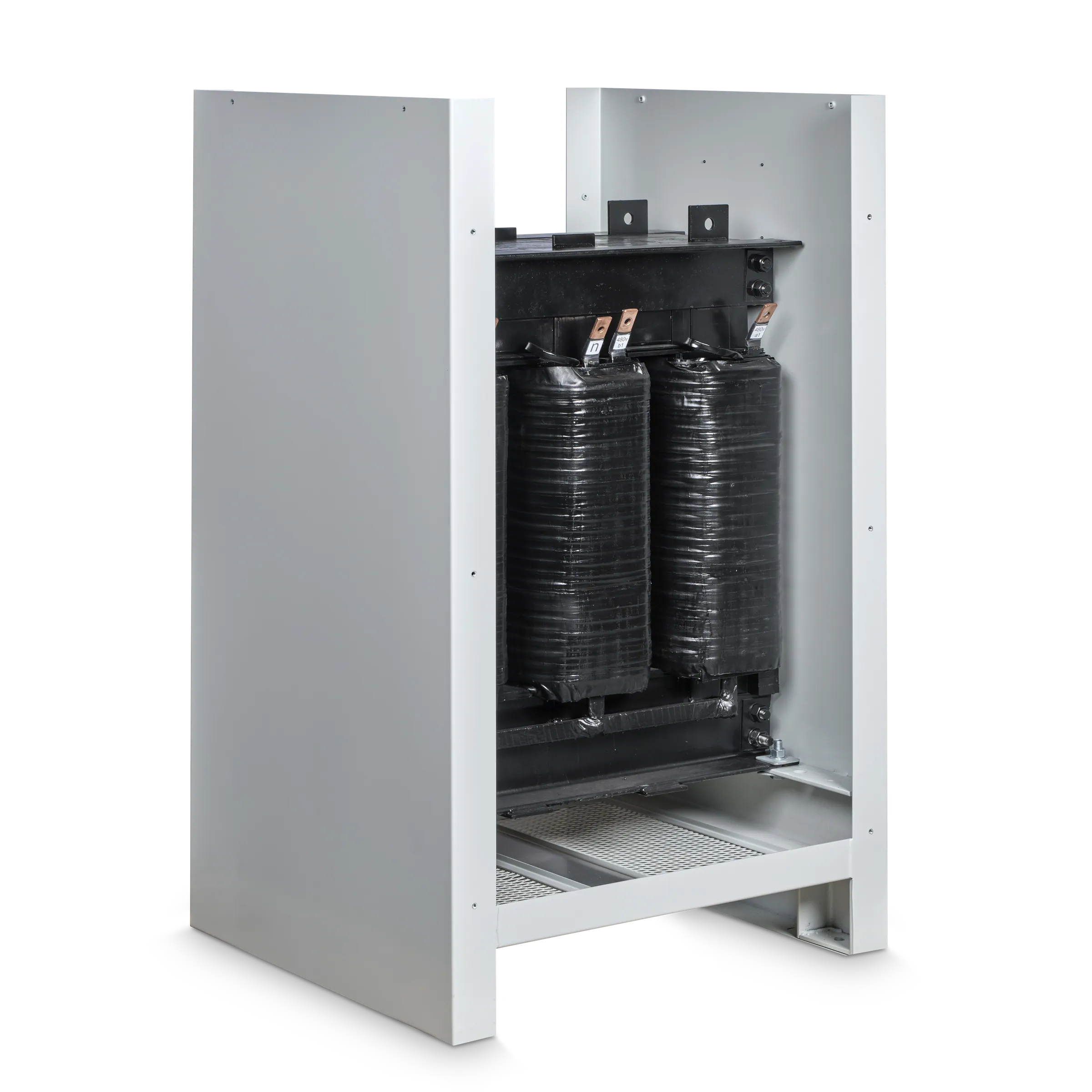
Open-wound dry-type — what we build — has no oil, so no bunding, no containment and no restriction on indoor or underground installation. It can be rewound rather than replaced, which matters on a remote site or a long-life asset. And because there’s no tooling involved, a non-standard voltage, an unusual vector group, extra tappings or a specific footprint cost design time rather than a new mould.
The honest trade-off: in a genuinely harsh atmosphere, an open-wound unit needs the right enclosure around it where a cast resin unit might not. That’s what the IP65 option is for, and it’s a cheaper problem to solve than the ones the other two bring.
In short: if you’re buying a standard distribution transformer for an outdoor pad and bunding is no obstacle, oil is hard to beat on cost. If the job is project-specific, has to go somewhere oil can’t, or needs to be repairable in fifteen years’ time, dry-type is the one that fits.


Transformer Solutions Made Simple
Provide your project details and we’ll respond promptly with expert guidance tailored to your needs.

Australian-Made. Built to Last
All Southern Transformers products are locally designed and manufactured for long service life, with full compliance to Australian Standards.

Custom-Built for Industrial Demands
From commercial industries to major sectors, we tailor each transformer to meet the real-world needs of your application – no limitations.

Delivered to Your Schedule without Compromise
We understand project timelines matter – Southern Transformers delivers transformers to meet your schedule, fast or slow, without cutting corners.

5-year Warranty, 25+ year design life
Every transformer is designed and built to operate continuously at rated power for 25+ years, backed by an industry-leading standard 5-year warranty.
Step up, run the distance, step down
One of the most useful things you can do with a pair of these has nothing to do with the equipment at either end.
If you need to get power a long way across a site, running it at 415 V means large cable and volt drop you can’t design out. Step it up to 1,000 V at the source, run the distance at a third of the current, then step it back down to 415 V where it’s needed — and the cable gets substantially smaller and the volt drop goes away.
The reason this works well at 1,000 V is that it stays low voltage. You avoid HV switchgear, HV cable, HV-rated terminations and the approvals and competencies that come with them, while getting most of the benefit of transmitting at a higher voltage.
We build these as matched pairs, engineered together — the step-up unit and the step-down unit are designed as one job so the vector groups, impedances and earthing arrangements work with each other rather than being two transformers that happen to be on the same site.
Related reading: a smarter way to tackle long cable runs


What we need to quote
- Supply voltage and whether it’s 3-wire or 4-wire
- The voltage you need, and which way round
- Load in kVA, or the connected equipment list
- Indoors, outdoors, underground, or inside your own enclosure
- Ambient temperature range, and altitude if above 1,000 m
- Space available, and how the unit gets into position
- Any specified impedance, vector group, fault level or project standard
- Earthing arrangement required on the LV side
If all you have is a single line and a site address, send that.
Transformer Solutions Made Simple
Provide your project details and we’ll respond promptly with expert guidance tailored to your needs.